
Around three million fire exit doors are put in the UK each year, and for good reason. They’re typically the first line of defence in the case of a fire and play an important role in ensuring that structures are safe. Closing off a space while restricting the supply of oxygen to avoid flames from spreading quickly throughout a building. I will be covering the importance of having a fire exit door for your business.

Fire exit doors (also known as fire escape doors or emergency exits) are a must-have in reducing the number of deaths and injuries caused by fire. This emphasizes the need for all doors on escape routes leading to the final exit to be quick and simple to open without the need for a key. However, the final exit door of a structure might be an issue since it needs greater security while also having to be readily accessed from within.
In England alone, according to the government’s fire and rescue incident reports, there were 177,844 fires in 2018. This compares to a 4% growth over the previous year. These figures illustrate the significance of having fire exit doors installed, maintained correctly, and in accordance with UK Government laws.
What is a Fire Exit?
A fire exit is generally defined as a way of leaving a building in the event of a fire or a door that is utilised to allow individuals out of a building when there is a fire. It’s critical to note that emergency exits may be used in conjunction with other types of exits and routes for an accelerated evacuation while also providing another option if the regular is blocked.
The following requirements must be met by a fire exit:
It must be in a position that is easily accessible
The exit must have the capacity to bring people in the event of an emergency, such as a fire
It must be controlled by the inside of the building
It must be well managed and regularly maintained
It must be in a fixed location
It’s also critical to understand the distinctions between a fire door and a fire exit door. There are several differences between them, which you may discover more about here.
The Specifications for a Fire Exit Door
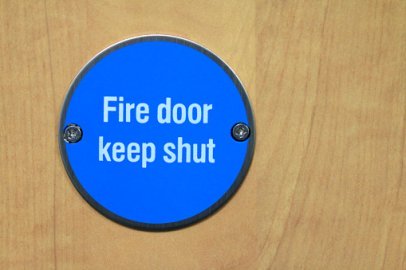
Exit doors do not have to be made to withstand and prevent the spread of fire. Their primary goal is to allow people to flee the building as quickly as possible in the case of an emergency by opening swiftly and easily. The Regulatory Reform (Fire Safety) Order (RRFSO) 2005, also known as the Fire Safety Order, states that the:
- Fire exit doors must open in the direction of escape and sliding or revolving doors must not be used for exits specifically intended as emergency exits.
- Fire exit doors must not be locked or fastened in a way that they cannot be easily and immediately opened by any person in an emergency situation.
- If the door is also to provide security, a fire exit door can be locked from the outside, but must be fitted with an emergency push bar (or other emergency access device) to allow a quick escape.
- Fire exits must be clearly marked and identifiable using adequate lighting and/or signage.
Fire Exit Signage
The legislation states that a fire exit must be clearly marked and kept free of obstructions. This may take the form of an illuminated sign and or stickers
How Many Fire Exists Do You Need?
There is no legal requirement for how many fire exits you must have in your business, however, there are standards set forth in the Building Regulations document to satisfy fire safety requirements. If feasible, the government recommends that more than one fire exit be provided from your facility. These exits should be completely independent and have separate escape routes if practical.
Three factors influence the number of fire exit doors needed in a premise:
- The number of occupants in the room
- The number of tiers or storeys in a building
- The limits on travel distance to the nearest exit
The government standard recommends that for up to 60 people, one fire exit is required, whereas, for up to 600 persons, two fire exits are necessary. In the case of more than 600 individuals, at least three fire escapes are needed.
It’s crucial to make sure that each resident has a way out in case of an emergency. For example, if there is one exit, it may be difficult for people to reach it or find their way around the premises since they have no idea where they are going. However, if a structure boasts more than one entry point and lacks a clear escape.
Who is Responsible for The fire Door?
The Regulatory Reform (Fire Safety) Order 2005 provides that, in any non-domestic facility, a “Responsible Person” must be identified, and it is his or her responsibility to ensure that fire safety standards are met. The Responsible Person is usually an employer, landlord, building manager, or managing agent at a school. This means that as well as having a moral obligation to ensure access control systems adhere to the latest regulations, there is also a legal requirement for those in charge.
As the individual in charge of putting these rules into action, they must ensure that the premises fulfil the necessary criteria and that building occupants are given adequate fire safety information.
The Fire Safety Order extends to almost all structures, areas, and buildings, including shared living spaces in apartment complexes (HMOs), blocks of flats, and maisonettes. Individual private houses are not covered by the Order.
Maintenance and Testing of Fire Escape Doors
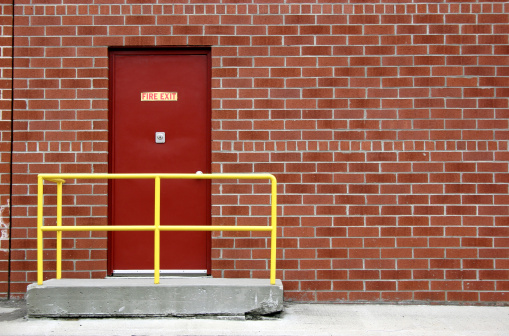
In the event of an emergency, maintenance and testing of pathways, stairwells, corridors, escape routes, fire alarm systems, fire-fighting apparatus, warnings, and emergency lighting are just a few examples
All fire safety fixtures and fittings must be inspected, serviced, and maintained on a regular basis.
An employer or nominated employee can be designated to perform safety checks and basic maintenance on emergency routes and equipment. However, it is advised that routine maintenance of fire-fighting equipment and systems such as fire alarms and lighting be performed by a competent individual to assure the dependability, safe operation, and need for any necessary repairs.
Every site will have its own demands, depending on the size and layout of the facility and the number of persons who will be utilising it.
A Fire Safety Checklist below:
Daily – Responsible individuals or wardens should verify that all escape routes are kept open, as fire doors should swing freely; and that there are no fire hazards such as visibly faulty electrical equipment or flammable materials left close to a heat source.
Weekly – Inspect fire alarms to ensure they are in working order. Every six months, according to BS5839, fire alarm systems should be inspected by a “competent person.” The UK government also adheres to this requirement.
Annually – Fire extinguishers should be serviced at least once a year, to check for faults and ensure that the extinguisher has a long and healthy life. Fire suppression systems also require routine maintenance, which will vary depending on the specific products and environments in which they’re kept.
Every Five Years – In most cases, fire extinguishers should be replaced after five years. The extinguisher must be completely discharged, internally examined for corrosion and refilled and re-pressurised
5 Top tips for fire exit regulations in the workplace
With all the above information in mind, see below our 5 top tips for managing fire exit regulations in the workplace:
- Carry out a fire risk assessment of the premises and review it regularly
- Tell staff or their representatives about the risks you’ve identified
- Put in place, and maintain, appropriate fire safety measures
- Plan for an emergency
- Provide staff information, fire safety instruction and training
In Conclusion
The rules around fire doors are clear and there for a reason. They’re a critical piece of kit to protect against fire damage. Proven to save both lives and protect against property damage.